How do Kalshi and Polymarket settle a market?
ThinBlimp guide · rules read from each venue's own documentation on November 7, 2026 · nothing here is advice
Every prediction market settles on the rules written into that market, not on its title. A winning contract pays $1 and a losing one pays nothing. What differs is who decides the outcome, how long it takes, and what happens if someone disagrees.
The rules side by side
| Kalshi | Polymarket US | Polymarket International | |
|---|---|---|---|
| Who decides | Kalshi's markets team finalizes the result | The exchange confirms the outcome | Anyone can propose a result, and it stands unless challenged |
| What it relies on | The source named in the market's rules | The sources listed in the rules, with backups on some contracts | The source named in the rules |
| How long it takes | Often about 3 hours after the outcome is known | No time stated in its documentation | About 2 hours after a proposal |
| If it is challenged | Check the rules, then contact Kalshi in the app | Settlements are final under its Exchange Rulebook | 4-6 days, ending in a vote of UMA token holders |
| Payout | $1 per winning contract | $1 per winning contract, unless the market sets other terms | $1 per winning token, or $0.50 each in a rare 50-50 |
Every market carries its own rules text, so that text is the final word.
Why a market can stay open after the event is over
A market staying open does not mean the outcome is in doubt. Kalshi says it often has to wait for a source agency to publish final data, and that trading can continue while it waits. It also says markets are not re-settled because an event seemed to conclude while trading was still open. Some of its markets set a determination time later than the event itself, so check the rules before assuming a settlement is late. Kalshi suggests contacting it if about 12 hours have passed and the rules give no later time.
How a challenge works on Polymarket International
Polymarket International settles through UMA's oracle. A proposer picks the outcome and posts a bond, typically $750. Anyone can dispute it during a 2-hour window by posting the same bond.
The first dispute starts a new proposal round. If the second proposal is disputed too, the question goes to a 24-48 hour debate, then a vote of UMA token holders that takes about 48 hours. Neither Kalshi nor Polymarket US settles this way: each exchange decides the outcome itself.
The same question can settle two ways
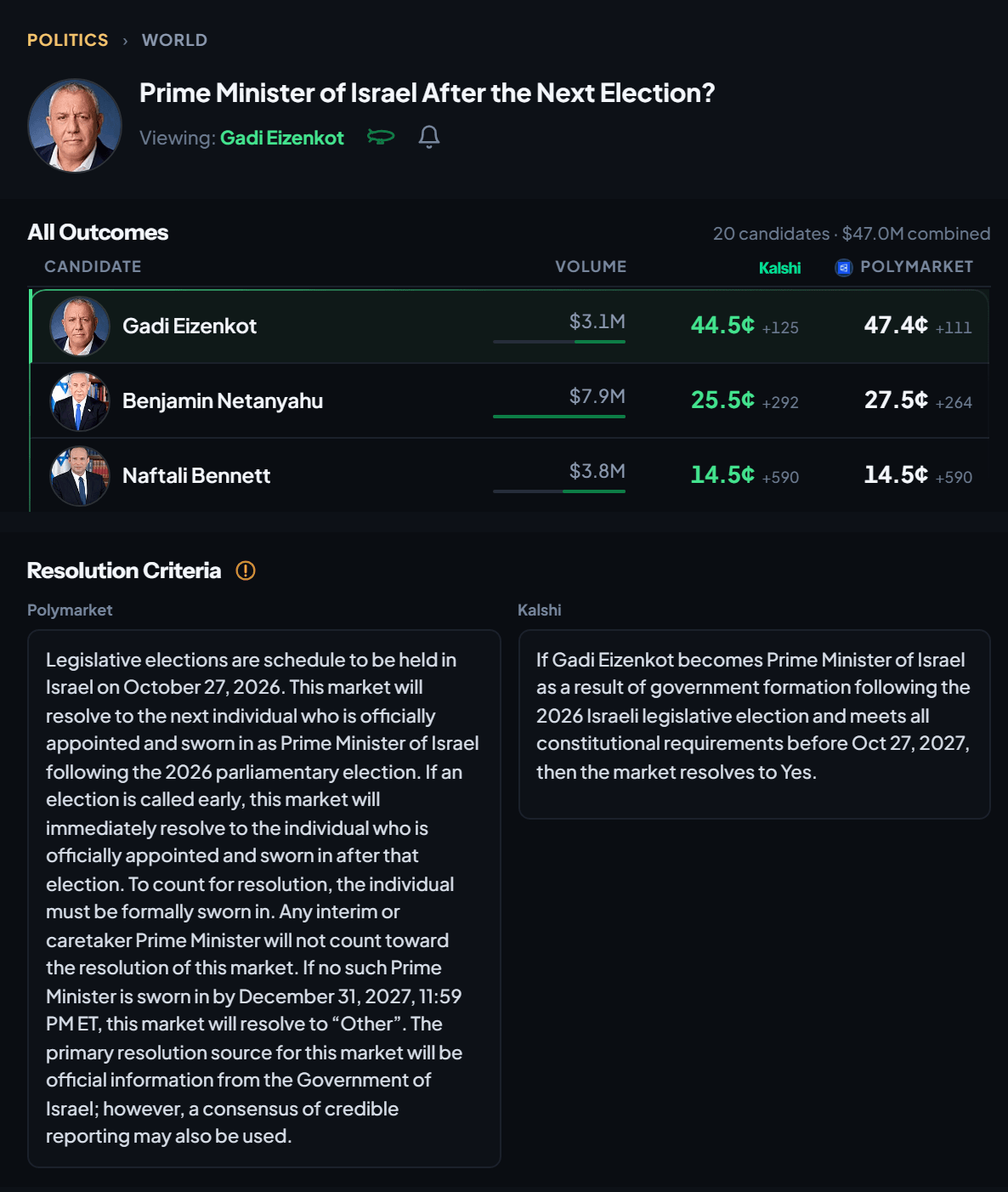
Two markets can read alike and still pay differently, which is the usual reason a large gap between venues is not a free trade.
- Leaving office. On Kalshi's "Pete Hegseth out as Secretary of Defense?" a departure needs an actual date and the role vacated within the period. Polymarket US settles on the announcement. So Kalshi was pricing a harder question, and an 8¢ gap on the November 30 line was that rule, not an edge.
- The Iran memorandum. Polymarket International resolved "US-Iran nuclear deal by June 30?" Yes on June 15, because its rule asked for a publicly announced mutual agreement. On June 17 Kalshi posted a clarification saying the memorandum did not meet its criteria at that time.
What to check before you trade
- The source. Find the exact source the market names, because a different source can report a different result.
- The deadline. Check whether the event must happen by the date, or be announced by it.
- The secondary rules. On Kalshi, the qualifying details can sit below the first rule you see.
- The other venue's rules. Read both before treating a gap as a real difference in price.
For what happens when a game moves, see postponed games. For why two venues show different prices, see the same market at different prices.
Questions
How long does Kalshi take to settle a market?
Kalshi says most markets settle within a few hours after the outcome is known, often within about 3 hours. It can take longer when it is waiting on official data, or when the rules set a later determination time.
Who decides the outcome on Polymarket US?
The exchange. It confirms the outcome using the sources listed in the market’s rules, and Polymarket Clearing then settles the contracts. Settlements are final under the Polymarket US Exchange Rulebook.
Does Polymarket US use UMA?
Its documentation says the exchange determines each outcome. UMA’s oracle is how Polymarket International resolves its prediction markets.
What happens if a Polymarket result is disputed?
On Polymarket International, a first dispute starts a new proposal round. A second goes to a 24-48 hour debate and then a vote of UMA token holders, so a disputed market takes 4-6 days in all.
Why is a Kalshi market still open after the event ended?
Kalshi says it often has to wait for a source agency to publish final data, so a market staying open does not mean the payout criteria have not been met.