How the Screener finds the cheapest fill
ThinBlimp guide · facts checked October 18, 2026 · prices read live from the venues' order books · nothing here is advice
You have already picked a side. The Screener answers the next question: where do you get it cheapest, for your size, after every fee? It reads the order books of Kalshi, Polymarket US and Polymarket International, walks them from the cheapest contract up, and shows what the same order would cost on each venue alone. It never tells you which side to take, and it never places an order: the button opens the venue's own page.
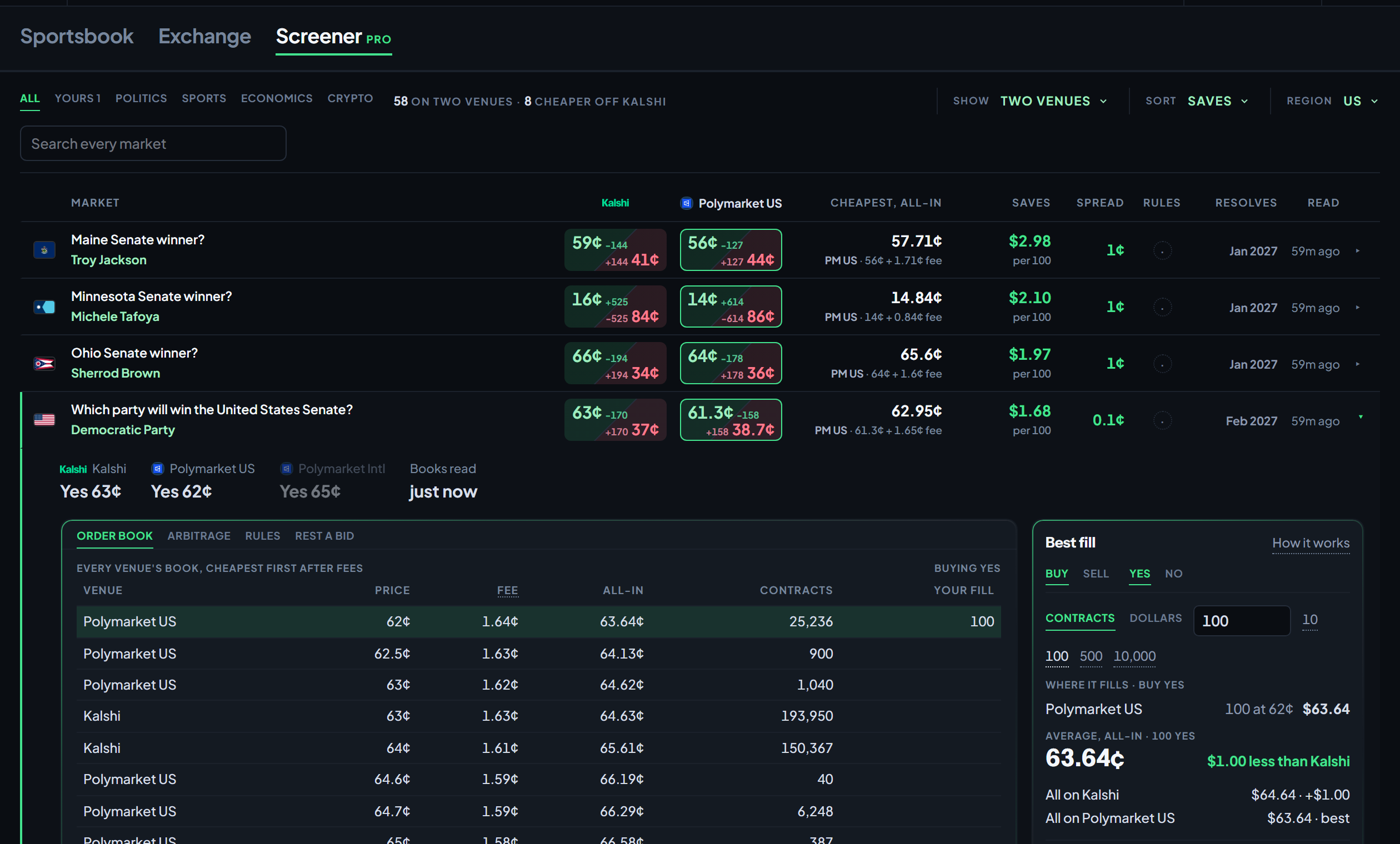
Two ways in
- The Screener tab lists every market priced on more than one venue, sorted by how much the cheapest venue saves against Kalshi on each contract, at the top of each book and after fees (or by spread, 24-hour volume or resolution date). Open a row to price your own size, with the order book, the arbitrage calculator, both venues’ rules and a resting bid on tabs beside it.
- Best fill on any Exchange row or Sportsbook card opens the same numbers beside the board, so you can check a price without leaving the market you were reading.
A worked example: 500 contracts of Yes on Senate control
The market is "Will Democrats win the U.S. Senate in 2026?", read on the evening of October 17. You want 500 contracts of Yes and you trade from the US, so Polymarket International is left out (it is not open to US accounts).
The cheapest Yes on Polymarket US was 61.3¢, with 5,067 contracts on offer at that price. Polymarket US charges a taker fee of 0.0695 × price × (1 − price) per contract, which at 61.3¢ is about 1.65¢. So 500 contracts cost:
| Price | Fee | Total | |
|---|---|---|---|
| Polymarket US, 500 at 61.3¢ | $306.50 | $8.24 | $314.74 |
| Kalshi, 500 at 63¢ | $315.00 | $8.16 | $323.16 |
Kalshi's best Yes was 63¢. Its fee is 0.07 × price × (1 − price) per contract, about 1.63¢ at 63¢, and Kalshi's schedule rounds an order's fee up to the next cent, so $8.1585 becomes $8.16. It rounds once for the whole order, even when the order fills at more than one price. Kalshi's own ticket for this order read $323.17, a cent above the arithmetic: at some sizes its ticket adds a cent to the contract cost.
The whole order fills on Polymarket US. The average all-in price is 62.95¢ a contract against 64.63¢ on Kalshi: $8.42 less on the whole order.
The other side tells a different story. To buy 500 contracts of No, you pay 100 minus the best Yes bid. Kalshi's best Yes bid was 62¢, so its No costs 38¢; Polymarket US's best Yes bid was 61.2¢, so its No costs 38.8¢. No is cheapest on Kalshi. The cheapest venue depends on which side you buy.
Reading the Best fill panel
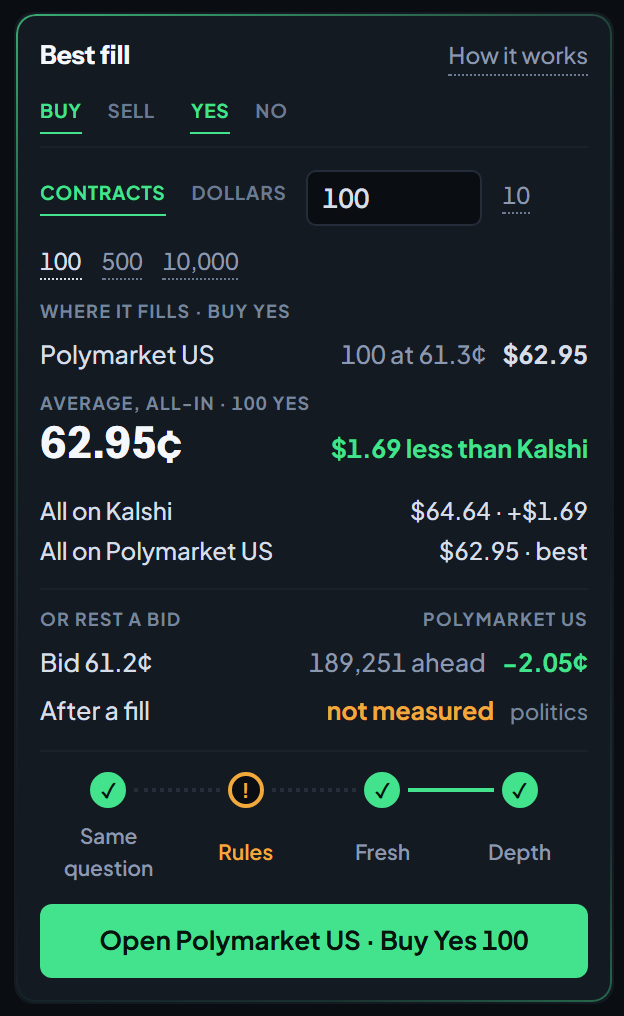
- Where it fills lists each venue in the fill, how many contracts, at what average price, and the total with fees. A large order can split across venues when the cheapest one runs out.
- Average, all-in is the whole order's cost per contract after fees. On a game it also shows the American odds.
- All on each venue is the same order on one venue alone, so you can see what the cheapest fill saves against the venue you usually use.
- Or rest a bid is the alternative to buying at the ask: join the best bid on whichever venue nets best after its maker fee, with the number of contracts already waiting there ahead of you. Resting saves the spread only if it fills, and bids usually fill when the price moves through them. On 744 October game markets a filled bid was worth 0.2 to 2.3¢ less fifteen minutes later. Politics books have not been measured, and the panel says so.
The four checks
Before the button, four checks run in a row:
- Same question. Every venue in the fill is paired as the same question. A venue whose contract settles on different rules is left out.
- Rules. Each venue writes its own rules. With more than one venue, this check is amber: tap it to read the venues' rule text side by side before you split an order across them.
- Fresh. Every venue in the fill answered the latest book read. A venue whose book is stale, held during a live game, missing, or too thin to trust is left out.
- Depth. The books can fill your size. If they cannot, this check turns red and the button is switched off, because a fill the books cannot give is not a price you can get.
Region
Polymarket International is not open to US accounts. The Region setting decides whether it counts: US leaves it out, Outside US includes it.
What the Screener does not do
It does not place orders, hold your money or hold your keys. It reads public order books and opens the venue's page for each part of the fill; you place the order there. Prices move between the read and your click, so the venue's own ticket is the final word on what you pay.
The Screener is part of ThinBlimp Pro. Without Pro, it prices 10 contracts so you can see the saving before you pay. See the Kalshi limit-order guide for more on resting versus taking, and Polymarket US vs Polymarket for how the two Polymarkets differ.
Questions
Does the Screener place orders for me?
No. It reads the public order books and opens each venue’s own page for your part of the fill. You place the order on the venue, which shows the final price.
Why is the cheapest venue different for Yes and No?
Buying No costs 100 minus the best Yes bid, so it depends on each venue’s bids, not its asks. On Senate control, Yes was cheapest on Polymarket US and No was cheapest on Kalshi.
Why is Polymarket International missing from my fill?
Polymarket International is not open to US accounts. Set Region to Outside US if you trade from outside the US, and it is counted everywhere.
What does it mean when the Depth check is red?
The order books cannot fill the size you entered, so no fill is a price you can actually get. The button is switched off until the size fits the books.