Why is the same market a different price on Kalshi and Polymarket?
ThinBlimp guide · rules and prices read from each venue on October 28, 2026 · nothing here is advice
Usually because it is not quite the same market: each venue writes its own rules, and a different deadline or a different answer to an unusual case changes what the contract pays. The rest of the gap comes from separate order books, different fees and price steps, and one venue simply trading more recently than the other.
A real case: Israel's next prime minister
At 10:45 PM ET on October 28, 2026, the day after Israel's election, these were the prices to buy Yes on Gadi Eizenkot:
| Polymarket | Polymarket US | Kalshi | |
|---|---|---|---|
| Best ask | 25.9¢ | 27¢ | 14¢ |
| Best bid | 25.8¢ | 26¢ | 13¢ |
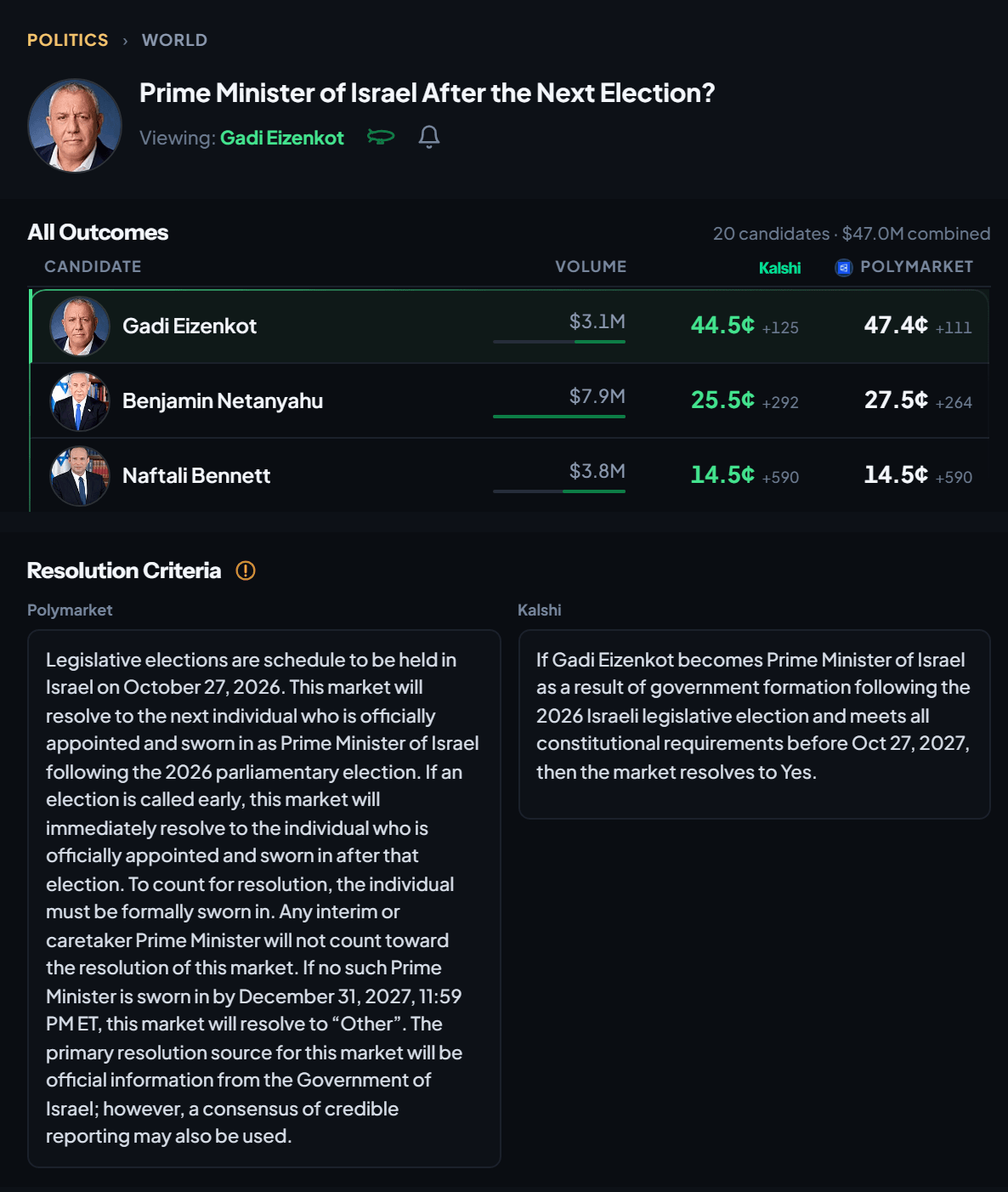
Two weeks earlier, on October 14, the two showed 47.4¢ on Polymarket and 44.5¢ on Kalshi, 2.9¢ apart.
Where do the rules differ?
All three pay Yes only to the person who forms a government after the 2026 election, and none counts an interim or caretaker prime minister. They part on what happens if Israel holds a repeat election before anyone forms a government:
| If a new election is called before a government forms | What the market does |
|---|---|
| Polymarket | Carries on: it resolves to whoever is sworn in after that election |
| Polymarket US | Carries on: it settles on whoever takes office after the new election |
| Kalshi | Ends: it resolves to "No one" and No for every candidate |
The deadlines differ too: Kalshi's market needs a government by October 27, 2027; Polymarket's resolves to "Other" if no one is sworn in by December 31, 2027.
So a Yes on Eizenkot is a bigger promise on the two Polymarkets than on Kalshi: it still pays if he wins a repeat election. The two venues with the same rule traded about a cent apart; Kalshi, with the narrower rule, traded at about half their price. Kalshi states the repeat-election rule in its secondary rules, which sit below the summary most screens show.
What else makes prices differ?
- Separate order books. A trade on one venue never moves the other. Each price is only what its own buyers and sellers agreed.
- Fees. Taker fees differ by venue and category, so the price that breaks even differs too. See Kalshi vs Polymarket vs Polymarket US.
- Price steps. A venue that moves in 1¢ steps cannot quote 56.75¢; one that moves in quarter cents can.
- Timing. On a quiet market one venue's last price can be hours older than the other's.
Sports markets differ on rules too, most often on postponed games; see what happens when a game is postponed.
Is a price gap an arbitrage?
Only if both contracts pay on exactly the same facts. Here, Yes on Kalshi at 14¢ plus No on Polymarket at 74.2¢ costs 88.2¢ for what looks like a sure $1. But if a repeat election is called and Eizenkot wins it, Kalshi pays No and Polymarket pays Yes, and both sides lose. The arbitrage guide covers the rest.
Questions
Why is the same market a different price on Kalshi and Polymarket?
Usually because the venues write different rules for it, so the contracts pay on slightly different facts. Separate order books, different fees and price steps, and one venue trading more recently make up the rest.
Why was Eizenkot cheaper on Kalshi than on Polymarket?
Kalshi’s market resolves to “No one” if Israel calls a repeat election before a government forms, while both Polymarkets carry on to whoever wins that election. On October 28 Eizenkot’s ask was 14¢ on Kalshi against 25.9¢ on Polymarket and 27¢ on Polymarket US.
Is a price gap between Kalshi and Polymarket an arbitrage?
Only if both contracts pay on exactly the same facts. When the rules differ, buying the cheap side on one venue and the opposite side on the other can lose on both.
Where do I find a market’s rules?
On each venue’s market page. Kalshi puts the full detail in its secondary rules below the summary; Polymarket and Polymarket US put it in the market description.