What do you get if you sell a Kalshi or Polymarket contract before the game ends?
ThinBlimp guide · facts checked October 28, 2026 · order book read October 15, 2026 · nothing here is advice
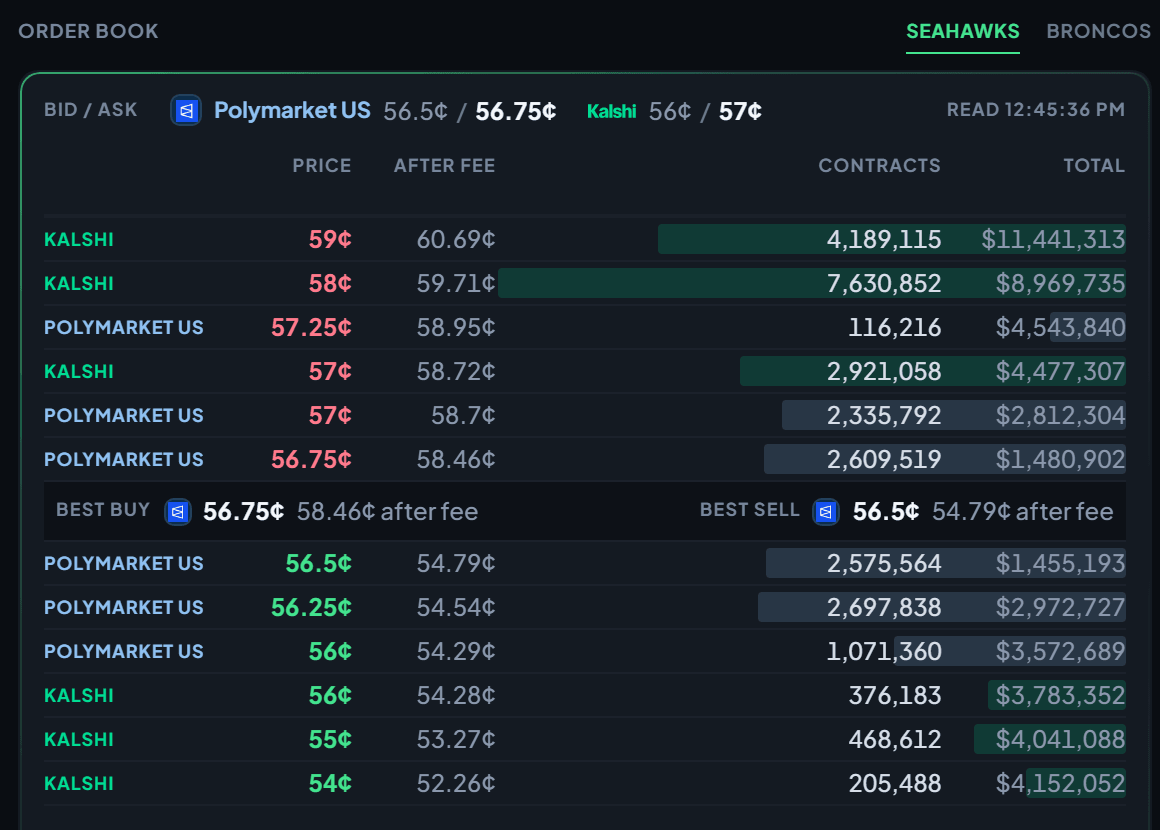
You get the best bid: the highest price a buyer is offering at that moment, minus the venue's fee, and not the price shown in big type on the market. Before Seattle played at Denver on October 15, selling 100 Seattle contracts paid $54.79 on Polymarket US and $54.27 on Kalshi, though the middle of both books sat at about 56.5¢.
What are the bid and the ask?
Every market has two prices at once.
- The ask is the lowest price a seller will take. Buying now pays the ask.
- The bid is the highest price a buyer will pay. Selling now gets the bid.
- The spread is the gap between them. You pay it every time you buy now and sell now.
The big number on a market is usually the midpoint or the last trade, which sits between the two. Neither is a price you can sell at.
What did selling actually pay?
Seattle to win at Denver, read from both order books at 12:45 PM ET on October 15, 2026, before kickoff. Each row is 100 contracts, fee included. Kalshi rounds each order's fee up to the next cent; Polymarket US rounds it to the nearest cent.
| Polymarket US | Kalshi | |
|---|---|---|
| Best bid (sell now) | 56.5¢ | 56¢ |
| Best ask (buy now) | 56.75¢ | 57¢ |
| Spread | 0.25¢ | 1¢ |
| Sell 100 now, after the fee | $54.79 | $54.27 |
| Buy 100 now, after the fee | $58.46 | $58.72 |
| Buy and sell straight back | lose $3.67 | lose $4.45 |
Most of that round-trip cost is the two fees, not the spread. Kalshi's taker fee is 0.07 × contracts × price × (1 − price); Polymarket US uses the same formula with 0.0695. Both are largest near 50¢.
Why is Polymarket US quoting quarter cents?
Each venue sets its own price step. Polymarket US sets it market by market: on October 28 its NFL game lines moved in 0.25¢ steps, a college football game in 0.5¢ and an NBA game in 1¢. Kalshi's NFL game markets move in 1¢ steps from end to end. A smaller step lets the spread get tighter, which is why the Polymarket US spread above was a quarter of Kalshi's.
What changes during the game?
The rule stays the same: a sale fills at the bid when your order reaches the book. What moves is the bid. It changes with every play, sometimes by many cents at once: that night Seattle fell to 5¢ after an interception and came back to tie the game. If you sell more contracts than the top bid holds, the rest fills at the next bids down, each a little lower.
Can I sell for more than the bid?
Yes, by waiting. Put a limit order to sell at or near the ask and it rests in the book until a buyer comes to you. It may never fill, and in a live game the price can run away from it. Kalshi charges resting orders nothing on most markets; see limit orders vs buying the ask. The fee calculator works out the fee on any trade, and what a price means covers odds and break-even.
Questions
What do I get if I sell my Kalshi contract before the game ends?
The best bid, the highest price a buyer is offering right then, minus Kalshi’s taker fee. Before Seattle played at Denver on October 15, Seattle’s best Kalshi bid was 56¢, so selling 100 contracts paid $54.27 after a $1.73 fee.
What is the difference between the bid and the ask?
The ask is the lowest price a seller will take, and buying now pays it. The bid is the highest price a buyer will pay, and selling now gets it. The gap between them is the spread.
Why does selling right after buying lose money?
You buy at the ask and sell at the bid, and pay a fee both times. On Polymarket US before the Seattle–Denver game, buying and selling 100 contracts straight back lost $3.67; on Kalshi it lost $4.45. Most of that is the two fees.
Why does Polymarket US show prices like 56.75¢?
Polymarket US sets its price step market by market. On October 28 its NFL game lines moved in 0.25¢ steps, while Kalshi’s NFL game markets move in 1¢ steps.