

The states that moved before their polls closed
ThinBlimp research · November 2026 · prices from our election-night lane, read every 30 seconds on both venues, method on the page
On election night, prediction markets moved toward the final result in states that had not finished voting. At 6 PM ET on November 3, Kalshi and Polymarket US priced Democrats for 33.4 wins across 53 two-party races. They won 37.
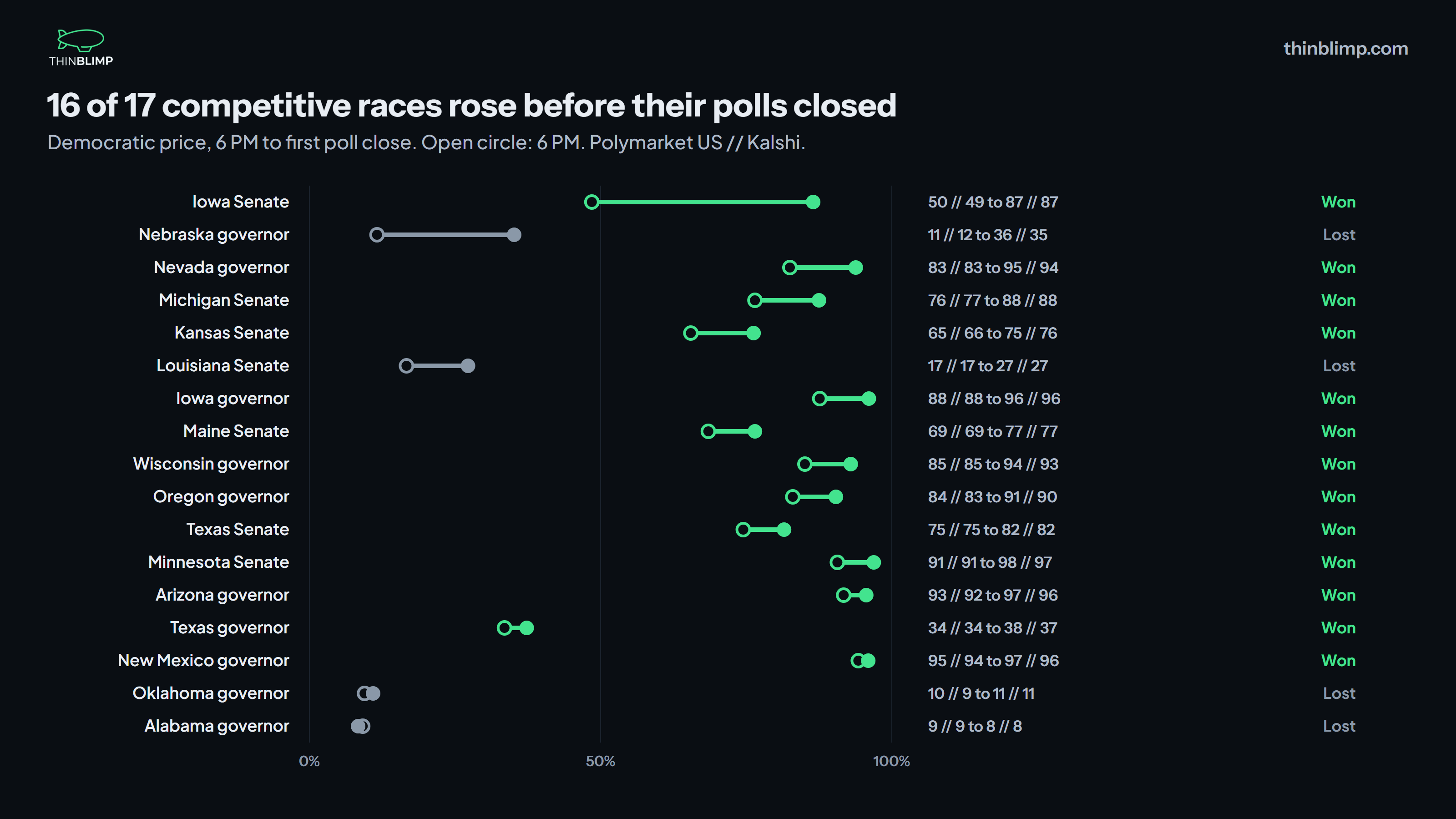
The 17 races with polls closing at 9 PM ET or later show how that gap closed. They were priced for 12.8 Democratic wins at 6 PM and 14.1 at each state's first poll close, and Democrats won 14. All 10 competitive races in that group rose before their polls closed.
Iowa's Senate race is the clearest case. Josh Turek's ask went from 50 // 49 at 6 PM to 87 // 87 at 9 PM, the minute Iowa's polls closed (Polymarket US // Kalshi throughout).
Both venues made that move together. Kalshi and Polymarket US never sat more than 0.08 wins apart on the late races, neither led, and almost no lock survived fees.
Why this question
The accuracy story is already told, so this study asks how the market changed its mind during the night. Kalshi says the favorite won 479 of 487 races. Polymarket says it called 10 key races a median 31 minutes ahead of CNN, Fox News and AP. RotoWire has published Brier scores for both chambers.
Those are scores on a final answer, and a hit rate has no direction. On the 53 races here, the 6 PM favorite won 50. All three misses went to Democrats: South Carolina Senate, Texas governor and Iowa Senate, the last of them a coin flip. A market can be right in 94% of races and still be short on one party by about four wins.
The timing claims compare markets with news desks. The question here is different: what did a price do while its own state was still voting?
Data and method
The prices come from ThinBlimp's election-night lane, which re-read 66 Senate and governor races on Kalshi and Polymarket US every 30 seconds, from 5 PM ET on November 3 to 6 AM on November 4. The race-level dataset holds the 53 races behind every total here.
- Democratic price: the Democrat's share of the two midpoints, D / (D + R), which removes the amount the two sides sum above 100. Prices quoted for one candidate are asks.
- Expected wins: the sum of those Democratic prices across a group of races.
- Poll close: the first close anywhere in the state, from The Green Papers. Texas counts as 8 PM, though El Paso closed at 9. New Hampshire counts as 7 PM, when most of its polls close.
- Competitive: priced between 5 and 95 on Kalshi at 6 PM.
- Result: each venue's settlement as of November 7.
Of the 66 races, 13 are left out, leaving 53:
- Independent on the board (8): Nebraska, South Dakota, Idaho and Montana Senate; Tennessee, Rhode Island, Maine and Michigan governor.
- Unresolved (3): Mississippi Senate, Alaska Senate and Kansas governor. Limits covers what they would change.
- No 6 PM price (2): Arkansas and Idaho governor.
Iowa: the price moved before the polls closed
Turek's Senate race went from a coin flip to a strong favorite with no Iowa returns possible. Polls there closed at 9 PM ET, and he was already 87 // 87.
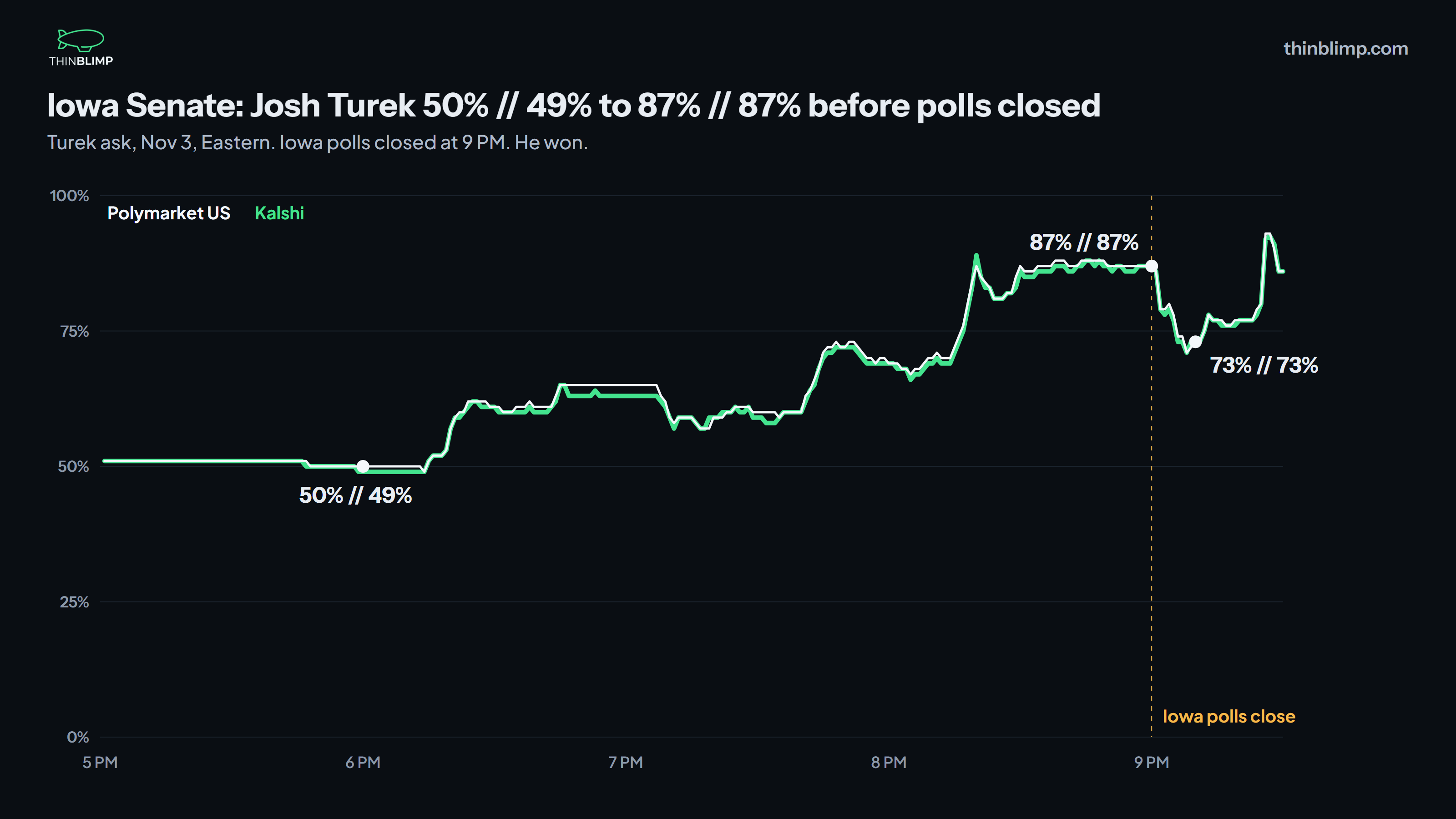
The move came in three steps, at about 6:15, 7:45 and 8:20 PM. Iowa then gave some back once its own count began, falling to 73 // 73 by 9:10 PM. Turek recovered to 94 // 93.7 by 10 PM and won.
The gap closed before the polls did
For races closing at 9 PM or later, the 6 PM shortfall of 1.2 wins was gone by each state's first poll close. In wider groups it shrank by more than half.
| Races by first poll close | Races | Expected D wins, 6 PM | Expected D wins, at poll close | Actual D wins |
|---|---|---|---|---|
| 9 PM or later | 17 | 12.84 // 12.81 | 14.09 // 14.06 | 14 |
| 8 PM or later | 39 | 26.16 // 26.14 | 27.83 // 27.84 | 29 |
| 7:30 PM or later | 43 | 28.65 // 28.63 | 30.46 // 30.47 | 32 |
The rise was close to universal, and it did not pick winners. On Kalshi, Democrats who won rose 9.6 on average and those who lost rose 8.7. Only four lost and Nebraska drives their figure, so the split is rough. It fits a market reading the night, not each race. By 8:55 PM all 11 races still voting had risen. One shift in log-odds, the size that takes a 50 race to 73, explains 74% of the differences between their moves.
Five checks support the result, and one limits it:
- Reading time: the 9 PM group reads 14.11, 14.14 and 14.05 at 5, 10 and 15 minutes before each close on Kalshi. The result does not depend on the exact minute.
- Quiet before the first returns: the 10-race average was 69.3 at 5:15 PM and 69.2 at 6:10 PM. On the 21 evenings from October 13 to November 2, the same 10 Democrats moved 0.08 on a typical evening from 6 to 9 PM and 0.8 at most, on Kalshi midpoints. On November 3 they gained 12.3.
- Scores improved only in Iowa: for the 17 races, the Brier score improved from 0.0250 at 6 PM to 0.0142 at poll close on Kalshi (lower is better). Iowa Senate accounts for all of that. Without it, the score worsened from 0.0100 to 0.0139, so the move fixed the total without sharpening most races.
- Not only Iowa: without Iowa Senate, the other 16 races go from 12.33 at 6 PM to 13.20 at poll close, against 13 actual. Dropping any one race leaves the 6 PM shortfall between 0.67 and 1.35 wins, and the poll-close gap between -0.20 and 0.29.
- Whole state closed: reading the 17 races at each state's last poll close instead of its first gives 14.12 // 14.09.
- Traded, not just quoted: Kalshi's Democratic contracts in the 10 competitive races traded 1.88 million contracts between 6 PM and each first close, about $1.3 million at traded prices. Iowa Senate alone traded 853,565, in every one of 180 minutes. Polymarket US volume was not read.
Resampling by state, so a state's two races stay together, puts the 6 PM shortfall between 0.0 and 2.6 wins (95% interval) and the poll-close gap between -1.1 and 0.8. For the 39 races, those intervals are 0.8 to 5.4, and -0.6 to 3.3.
Was the 6 PM price wrong?
Not provably: a miss this size is ordinary if races move together, and elections do. So this study can show when the total moved, but not that 6 PM was a mispricing.
| If outcomes correlate at | Chance Democrats reach 37 of 53, if 6 PM prices were exactly right |
|---|---|
| 0 (independent) | 6% |
| 0.2 | 22% |
| 0.4 | 28% |
| 0.6 | 32% |
These come from 100,000 draws of a one-factor model on the Kalshi 6 PM prices. The correlations are assumptions, not estimates. The market may have priced the risk correctly, then drawn from its Democratic side.
The timeline: four moves, one reversal
The market moved in bursts, not a steady climb, and the first came within 10 minutes of the first polls closing. At 6 PM, polls closed in most of Indiana and Kentucky. Neither state had a competitive race on this board, and no other state on it closed any polls before 7 PM. The 6:10 PM move in those other states came with their polls open.
| Window (ET) | Senate control, D ask | Races with no polls closed, up / down by 1+ (Kalshi) | Largest moves among those races, D (Kalshi) |
|---|---|---|---|
| 8:10 to 8:30 PM | 94.7 // 94.6 to 97.3 // 97.2 | 10 / 0 of 18 | Iowa Senate 69 to 86, Alaska Senate 77 to 87 |
| 7:30 to 7:50 PM | 80 // 80 to 90 // 89 | 13 / 2 of 42 | Iowa Senate 58 to 72, Mississippi Senate 11 to 23 |
| 7:00 to 7:30 PM | 87.6 // 87 to 80 // 80 | 4 / 11 of 42 | Texas governor 45 to 33, Mississippi Senate 20 to 11 |
| 6:30 to 7:00 PM | 81.1 // 82 to 87.6 // 87 | 16 / 4 of 46 | Texas governor 40 to 45, Arkansas Senate 4 to 9 |
| 6:10 to 6:30 PM | 74.9 // 75 to 81.1 // 82 | 23 / 1 of 55 | Iowa Senate 49 to 61, Ohio Senate 73 to 82 |
The 7 PM reversal shows these prices were reacting, not drifting. Florida's governor race fell from 37 to 12 for Democrats in the half hour after most Florida polls closed, and races still voting fell with it. Iowa slid from 63 to 58. In the 8:10 PM window, 11 competitive races still voting rose 4.5 on average and 18 already counting rose 4.4, though single counting states moved far more: Kansas governor went from 40 to 74 and South Carolina Senate from 74 to 91.
Indiana's 5th District is the likeliest first trigger, but timing is the only evidence. The Democrat, J.D. Ford, went from 17 // 17 at 6:06 PM to 59 // 51 at 6:10 PM. Kentucky's 6th moved from 61 to 70 on Kalshi by 6:10. Iowa's first move came at 6:15. RG reports the night's largest bet, $949,299 on Democrats winning the House, came on Polymarket at 6:01 PM. Ford won a seat Trump carried by nearly 17 points. This study did not match each later burst to a county's returns.
Two venues, one price
Kalshi and Polymarket US made this move together, and neither led. Most studies of this night score one venue or compare a venue with the news desks. The lane read both on the same clock.
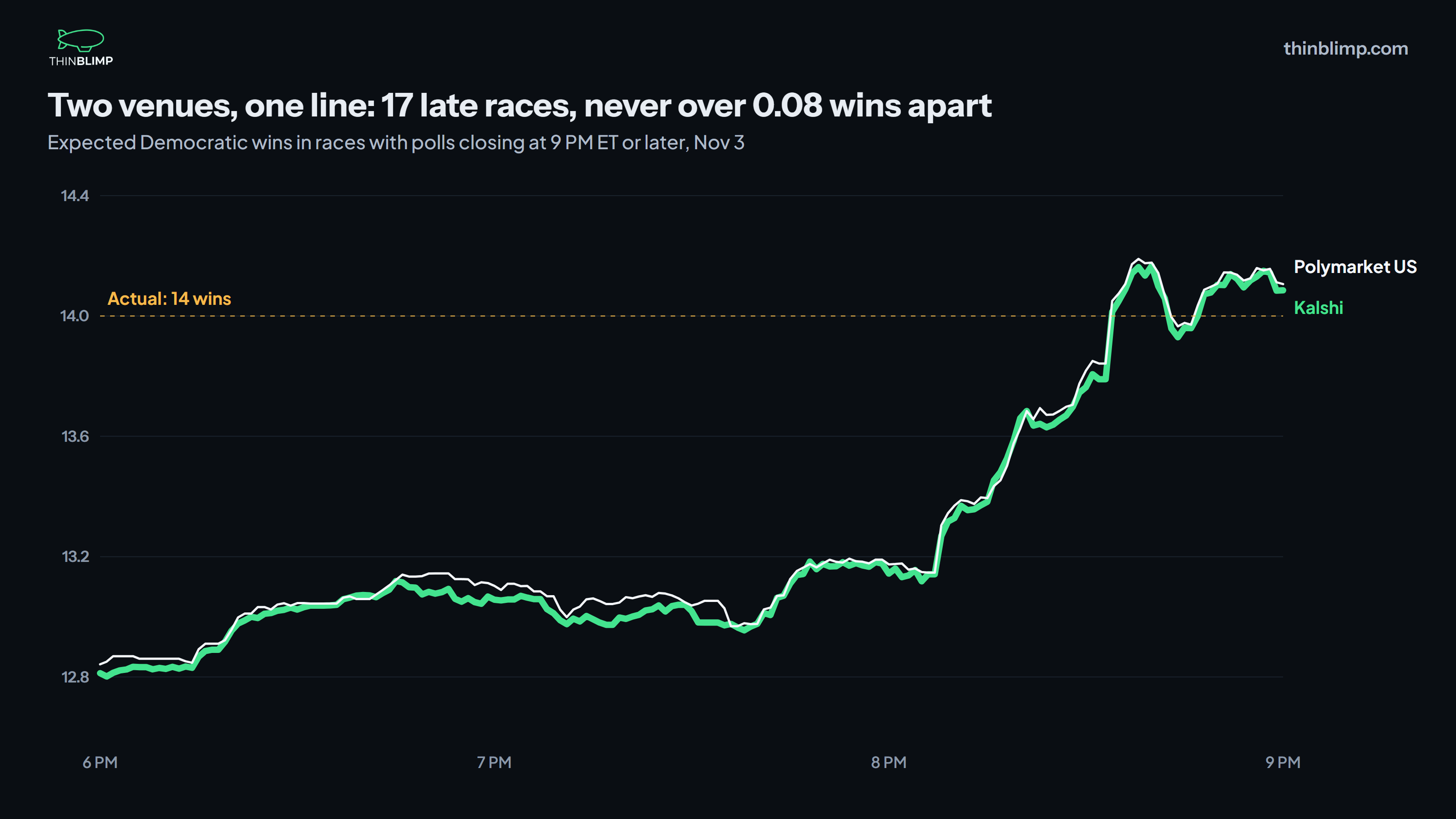
Race by race, the competitive races sat a median of 0.4 points apart on the Democratic price, and 90% of 6,371 race-minutes were within 1 point. Minute-to-minute changes in the 17-race total correlated 0.85 in the same minute. With either venue moved one minute ahead, the correlation fell to 0.29 and 0.28.
Which venue showed a move first was close to even. This table counts moves in competitive races before their own polls closed.
| Move inside 5 minutes | Same read | Polymarket US first | Kalshi first | One venue only |
|---|---|---|---|---|
| 3 points or more | 23 | 9 | 13 | 13 |
| 5 points or more | 7 | 6 | 4 | 7 |
| 8 points or more | 3 | 3 | 3 | 1 |
When one venue got there first, the median lead was 30 seconds or less, which is one read of this lane. A faster lead would not show here. RG reports that Polymarket reached 99 first on the House and on California's governor race. That is a different test: the time to reach a level on outcomes already in view, on markets outside this board.
Prices this close left almost nothing to lock in. The lane paired each venue's Democratic ask with the other's Republican ask in the two-party races, with both legs between 5 and 95. Books past 95 are left out, because a small lock there just waits on settlement.
| Paired reads, 5 PM to 6 AM | Locks after taker fees | Lasted one read | Lasted longer |
|---|---|---|---|
| About 34,000 | 24, on 13 races | 23 | 1 |
The one that lasted was Minnesota Senate at 7:59 PM: 4 minutes, and 0.13¢ a contract after fees. The four largest were all Mississippi Senate after midnight, while its count swung. Reads in a pass are seconds apart, so a one-read lock in a fast book may never have been fillable. The lane did not store depth. Fees are Kalshi's 0.07 rate and Polymarket US's 0.0695 rate that night.
Where it went wrong
The pre-close move got the total right and several races wrong. A price set by other states' votes says how the night is going. It does not say how one state will go, and four Democrats who peaked at 38 or higher lost. Most peaks did not hold: the lane reads every 30 seconds, so Nebraska's 53 was a single read.
| Race | Peak ask, D | Time (ET) | Seconds at peak | Ask at 9 PM | Result |
|---|---|---|---|---|---|
| Vermont governor | 66 // 67 | 7:16 PM | 60 // 32 | 5 // 4.9 | Lost |
| Florida governor | 39 // 39 | 6:53 // 6:52 PM | 330 // 330 | 1 // 0.9 | Lost |
| Louisiana Senate | 38 // 38 | 8:50 // 8:49 PM | 29 // 120 | 28 // 28 | Lost |
| Nebraska governor | 53 // 53 | 9:02 PM | 29 // 29 | 37 // 36 | Lost |
Once a state's own votes arrived, the group's prices came back down. The 10-race average fell from 81.3 at 9 PM to 75.7 at 9:20 PM, led by Iowa's drop and Nebraska's and Louisiana's collapse.
The largest reversal came much later and had nothing to do with the early move. Cindy Hyde-Smith reached 98 // 97.8 in Mississippi at 11:40 PM, then fell to 20 // 20 by the lane's end at about 6 AM.
Limits
This study measures when prices moved. It does not show why.
- Cause: the timing points to returns from other states, but no price carries a reason. "Before its polls closed" does not mean "no information about that state". Turnout and early-vote reports were available, and traders may hold private reads.
- Sample: one night and one wave. Races share a national swing, so they are not independent, and the intervals above are narrower than the true uncertainty.
- Open races: Mississippi Senate, Alaska Senate and Kansas governor had not settled on either venue on November 7. Mississippi was a 28-vote race just after midnight. They were priced for 1.2 Democratic wins at 6 PM. On November 7 the Democrats' Kalshi asks were 98.9, 96.8 and 99.6, and Polymarket US read about the same. If all three go Democratic, the total is 40 of 56 against about 34.5 expected.
- Not a trading result: these are midpoints summed across races. No strategy was tested. The lock count above includes taker fees but not depth.
- Margins: results here are wins and losses. Comparing each price move with the actual swing in votes would be a sharper test, and final margins are not in yet.
- Prior work: searches on November 5 and 7 found no published cross-state analysis of election-night prices. That is not proof that none exists.
Sources
- Prices: ThinBlimp election-night lane and catalog; Kalshi public one-minute and hourly candles; Polymarket US public price history.
- Poll closing times: The Green Papers.
- Hit rates and Brier scores: RotoWire, updated November 4.
- Polymarket's timing claim: CNBC, November 4.
- Indiana's 5th District: AP via PBS NewsHour, November 4.
- Mississippi's count: The Mississippi Independent, November 4.
- Largest bet and time to 99: RG, November 6.