Kalshi's pregame price is exactly as sharp as Pinnacle's. We checked 6,451 contract–book comparisons.
ThinBlimp research · October 2026 · all numbers from our own stored prices and settlements, method at the end
The question every prediction-market trader eventually asks is whether the exchange is softer than the sportsbooks. If it is, you line-shop between them. If it is not, you stop looking for that edge and go find the real one. We had the data to answer it, so we did.
The setup
Since June 28 we have stored a price for every Kalshi sports contract at least hourly, and since mid-September every minute while a game is in play. We also store the moneyline at DraftKings, FanDuel and Pinnacle for the same games. When a contract settles, we store the outcome. That gives us, for each settled contract, the price Kalshi carried the day before the game, the last line each book posted inside 36 hours of kickoff, and what actually happened.
Two things to know about the method before the numbers. The Kalshi price we use is the close of the day before the game (or the game day's opening print when there is no earlier day). That is hours older than the book line it is compared against, which hands the books a head start. And a book line is de-vigged two-way before it is compared to anything, so the comparison is fair-probability against fair-probability.
Finding one: the exchange and the books are the same forecaster
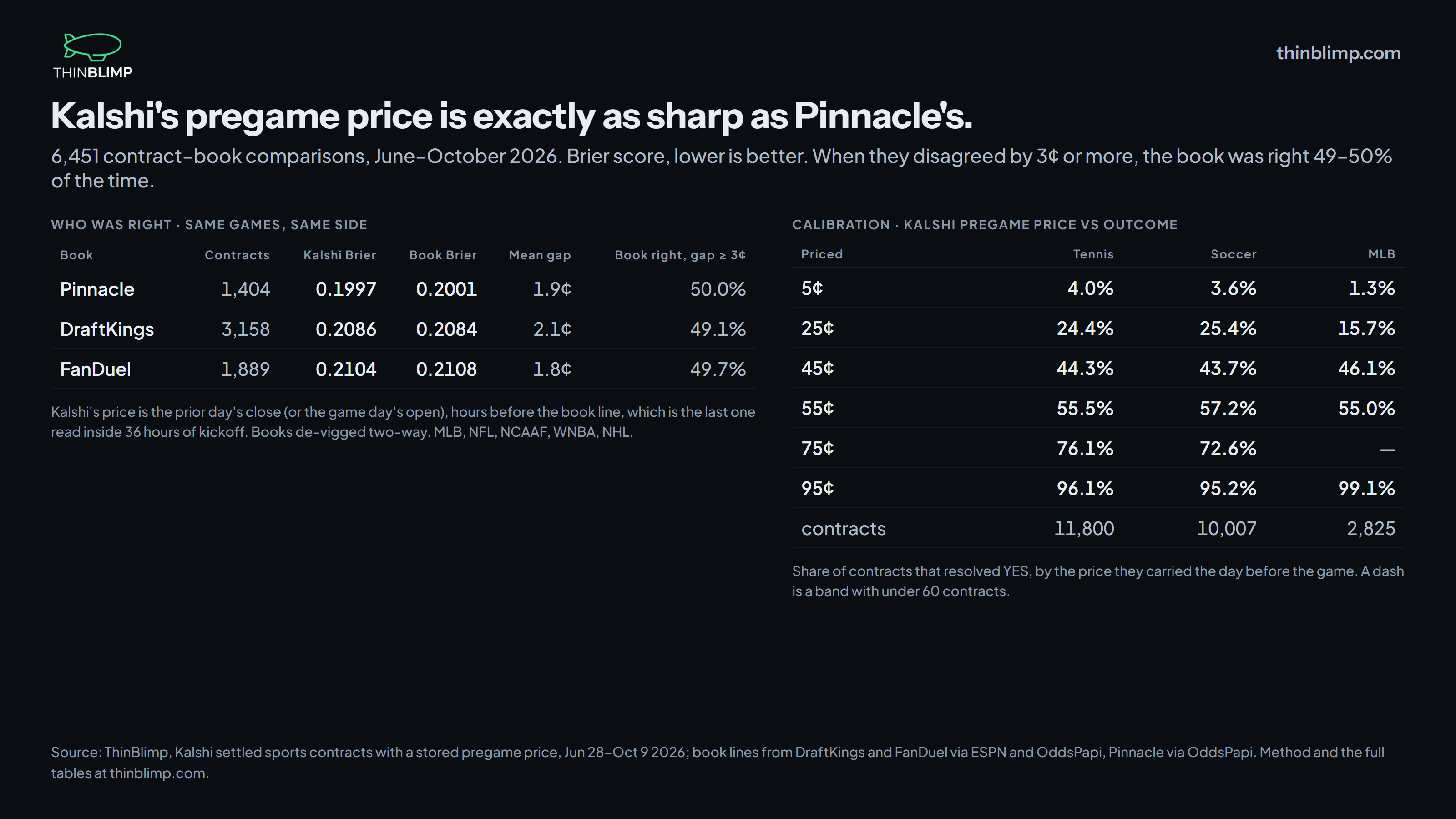
Brier score is the standard: the squared distance between the probability and the outcome, averaged. Lower is better. On the same contracts, same side:
| Book | Contracts | Kalshi Brier | Book Brier | Mean gap |
|---|---|---|---|---|
| Pinnacle | 1,404 | 0.1997 | 0.2001 | 1.9¢ |
| DraftKings | 3,158 | 0.2086 | 0.2084 | 2.1¢ |
| FanDuel | 1,889 | 0.2104 | 0.2108 | 1.8¢ |
The differences are in the fourth decimal. Kalshi's day-old price forecasts as well as Pinnacle's fresh one.
The sharper test is what happens when they disagree. We took every contract where Kalshi and a book were 3¢ or more apart (744 against DraftKings, 326 against FanDuel, 244 against Pinnacle) and asked who the outcome sided with.
| Book | Disagreements of 3¢ or more | Book's side won |
|---|---|---|
| Pinnacle | 244 | 50.0% |
| DraftKings | 744 | 49.1% |
| FanDuel | 326 | 49.7% |
A coin flip. When Kalshi and Pinnacle disagree about a game, neither of them knows something the other does not. That is the whole case against a "positive EV versus the book" scanner built on exchange moneylines: the gap it finds is noise, and a tool that sells noise as edge is selling a subscription to variance.
Finding two: the pregame price is calibrated, band by band
The other way an exchange can be soft is systematically, with favorites or longshots priced wrong on average. That is the famous favorite-longshot bias at racetracks and in some sportsbooks. We bucketed every settled Kalshi contract by the price it carried the day before the game and counted how often it resolved YES.
| Priced | Tennis | Soccer | MLB | NCAAF |
|---|---|---|---|---|
| 5¢ | 4.0% | 3.6% | 1.3% | 3.8% |
| 15¢ | 13.2% | 15.6% | — | 13.9% |
| 25¢ | 24.4% | 25.4% | 15.7% | 24.0% |
| 35¢ | 34.1% | 32.5% | 33.9% | 41.4% |
| 45¢ | 44.3% | 43.7% | 46.1% | 48.4% |
| 55¢ | 55.5% | 57.2% | 55.0% | 52.7% |
| 65¢ | 65.5% | 66.2% | 62.9% | 64.5% |
| 75¢ | 76.1% | 72.6% | — | 79.2% |
| 85¢ | 86.8% | 80.6% | — | 87.6% |
| 95¢ | 96.1% | 95.2% | 99.1% | 97.3% |
| contracts | 11,800 | 10,007 | 2,825 | 1,821 |
A contract priced at 45¢ wins 44% of the time in tennis, 44% in soccer, 46% in baseball. A 95¢ contract wins 95 to 99% of the time. There is no band to fade. Tennis at nearly twelve thousand contracts is as clean a calibration table as you will see from any sportsbook, and it comes from a venue that was running a fraction of this volume a year ago.
One detail for the people who will ask. A month ago our own first pass at this table looked badly wrong: contracts "closing" at 45¢ resolved YES only 25% of the time. That was a methodology bug, not a market. We had taken each contract's final traded price, and the final trade of a market that goes quiet before the game is not a pregame price at all. Measured at the day-before close, the anomaly disappears entirely. We mention it because it is the kind of thing a reader should check before trusting anyone's calibration chart, including ours.
Finding three: the two exchanges track each other to under a cent in play
Kalshi and Polymarket US list the same NFL, MLB and WNBA games. Across every minute both were quoting a game in play over the last week, the gap between them was 0.1 to 0.25¢ at the median and under 1¢ at the 90th percentile. A 5¢ gap showed up in 0.6% of minutes and did not last. The in-play arbitrage you will see advertised is real at the two-second horizon and gone at the human one.
So where is the edge?
Not in the price. In the cost of trading it.
On a Kalshi NFL moneyline the spread is one cent and the taker fee at the midpoint is another 1.5 to 1.7¢. Taking the ask therefore costs the half-spread plus the fee, about 2.1 to 2.7¢ per contract, which is 4 to 5% of a 50¢ contract. A resting order pays no spread and, on these contracts, a quarter of the fee. That is two to three times larger than any mispricing in the tables above. The venue charges a maker a quarter of what it charges a taker on these contracts, and the largest independent study of Kalshi trading, 72 million trades, found makers earning about 1.1% per trade and takers losing the same. The money is on the other side of the book, and it is there every day, on every game, which a mispricing never is.
That is what we are building next. Not a scanner that finds three things a week, but the resting price on every contract, the cents it saves against the ask, and how often a bid like it actually filled.
Method
Kalshi settled sports contracts with a stored daily price, June 28 to October 9, 2026, from our own catalog. Pregame price: the daily close on the day before the game's start date in Eastern time, else the game day's opening print. Outcome: the venue's settlement. Book lines: DraftKings via ESPN and OddsPapi, FanDuel and Pinnacle via OddsPapi, the last line stored inside 36 hours before kickoff, de-vigged by dividing each side's implied probability by their sum. Brier: mean of (p − outcome)². Bands: width 10¢ by the pregame price; bands under 60 contracts shown as a dash. In-play comparison: Kalshi and Polymarket US contracts on the same side of the same game, aligned by minute on our 60-second lane, from the game's start for four hours, prices between 3¢ and 97¢.